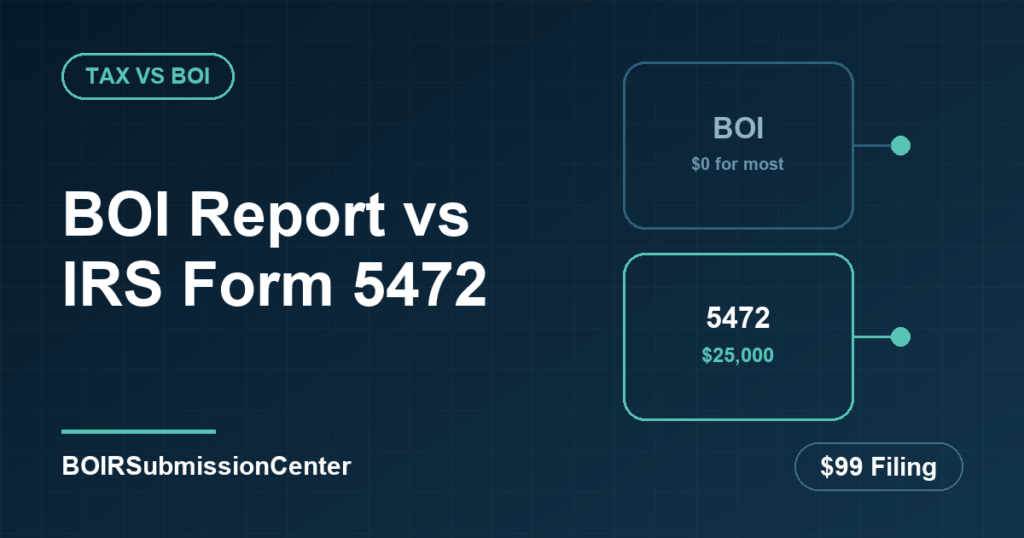
If you own a U.S. LLC as a non-U.S. person, the BOI report you were worried about genuinely does not apply to you any more. That part is settled, and anyone telling you otherwise is working from old information. Keep reading anyway, because the same fact that took you out of BOI reporting is what puts you inside a different federal filing — IRS Form 5472. It carries a $25,000 penalty, it is due every year, and it can apply even if your company earned nothing at all. Almost none of the pages explaining your BOI exemption mention it.
The Short Answer: Which of the Two Filings Applies to You
These are two unrelated obligations from two different agencies, and the one with far less publicity carries far more money.
| BOI report | IRS Form 5472 | |
|---|---|---|
| Who requires it | FinCEN (Treasury) | The IRS |
| What triggers it | Where the entity was formed | Who owns it, plus reportable transactions with related parties |
| Who is exempt now | Every entity created in the United States, and all U.S. persons | No broad exemption for a foreign-owned U.S. entity |
| What you file | A BOI report with FinCEN | A pro forma Form 1120 with Form 5472 attached |
| When | Within 30 days of registration — foreign-formed companies only | By the due date of the return it attaches to, including extensions |
| Penalty for missing it | $606 per day, adjusted (statutory base $500) — but almost nobody owes the filing any more | $25,000 flat, plus $25,000 for each 30-day period after a 90-day IRS notice, with no maximum stated |
The filing with the smaller headlines carries the bigger number.
Why You Were Told You Are Exempt — and Why That Was Correct
Your BOI exemption is real. It is not a pause, a suspension or a court order that might be reversed next month.
FinCEN’s interim final rule, published in the Federal Register on March 26, 2025 at 90 FR 13688, redefined which companies count as “reporting companies” so narrowly that entities created in the United States fell out of scope entirely. U.S.-formed entities file nothing — no initial report, no updates, no corrections. U.S. persons are separately exempt from providing their information.
The part that matters for this article is what the test turns on: where the entity was formed, not who owns it. A Wyoming LLC owned entirely by residents of another country is a U.S.-formed entity. Your nationality does not change the answer, and your BOI exemption is not a favour — it is the plain reading of the rule.
For the full picture of who is out of scope, see our guide to BOIR exemptions in 2026, and for how the Act ended up here, the Corporate Transparency Act explained.
It is worth naming why the two obligations get tangled together in the first place. Both are federal. Both ask who really owns a company rather than what it earned. Both arrived in the same few years, and both were explained to small business owners through the same channels — registered agents, formation services, accountants passing on second-hand summaries. When the BOI requirement was withdrawn for U.S.-formed companies, that news travelled through those same channels as “you do not have to report your ownership any more,” which is true of one filing and false of the other. The two are unrelated in law and easy to conflate in practice.
What Is Form 5472, Exactly?
Form 5472 is an IRS information return, not a tax return and not anything to do with FinCEN.
Its full title is “Information Return of a 25% Foreign-Owned U.S. Corporation or a Foreign Corporation Engaged in a U.S. Trade or Business.” It exists to report transactions between a U.S. entity and its foreign related parties, under Internal Revenue Code sections 6038A and 6038C. The form does not calculate tax. It discloses relationships and money moving across them.
A corporation is 25% foreign owned, in the IRS’s own terms, when it has at least one direct or indirect 25% foreign shareholder at any time during the tax year — measured by at least 25% of the total voting power of all voting stock, or 25% of the total value of all classes of stock.
Two quick disambiguations, because the numbers look alike. Form 5471 is the mirror image: U.S. persons who own foreign corporations file that one. FBAR is a report of foreign financial accounts and is a different obligation again. Neither is covered here.
Who Has to File Form 5472
Foreign-owned single-member LLCs (disregarded entities)
This is the group most likely to be caught unaware, and the filing is not what people expect.
A foreign-owned U.S. disregarded entity does not file the form on its own. It files a pro forma Form 1120 with Form 5472 attached, with “Foreign-owned U.S. DE” written across the top of the Form 1120. It is due by the due date of that pro forma 1120, including extensions. It goes in by fax to 855-887-7737, or by mail to Internal Revenue Service, 1973 Rulon White Blvd, M/S 6112, Attn: PIN Unit, Ogden, UT 84201.
The word “disregarded” is what trips people. Your single-member LLC being disregarded for income tax purposes means the IRS looks through it to you for tax. It does not remove this reporting obligation. Plenty of owners have concluded that because their LLC files no income tax return, it files nothing at all.
Why a company with no income still files
Because a reportable transaction is not the same thing as revenue.
Part V covers amounts paid or received in connection with the formation, dissolution, acquisition and disposition of the entity — the instructions specify this includes “contributions to, and distributions from, the entity.” The money you put in to capitalise your LLC is a contribution to the entity.
That is why an LLC with no customers, no invoices and no bank activity beyond the owner’s opening deposit can still have a reportable transaction for the year. The IRS instructions state what Part V covers; the conclusion that this obliges a zero-revenue LLC to file the form is the standard reading among practitioners — Taxes for Expats, for instance, states it explicitly. It is not a line the IRS spells out in those words, which is precisely why so many owners never reach it on their own.
U.S. corporations with a 25% foreign shareholder
The corporate case is narrower in one respect and broader in another. The 25% ownership threshold brings the corporation into scope, but the obligation attaches to reportable transactions with related parties during the tax year rather than to the company’s mere existence. If there were no reportable transactions, there may be nothing to report — a genuinely different position from the disregarded-entity case above.
What counts as a reportable transaction is worth understanding before you conclude you are clear. The form splits them across three parts. Part IV covers listed transactions for which money was the only consideration — sales, rents, royalties, interest, commissions, loans and similar dealings with a related party. Part V is the catch-all described above, covering formation, dissolution, acquisition and disposition amounts, including contributions and distributions. Part VI covers certain transactions or groups of transactions where non-monetary consideration was involved. A single item in any of them is enough to create a filing obligation for the year.
“Related party” is also broader than most owners assume. It is not limited to the direct owner. It reaches the 25% foreign shareholder, any person related to that shareholder or to the reporting corporation under the Internal Revenue Code’s attribution rules, and other entities under common control. A payment to a company your own parent happens to own can be a reportable transaction even if you have never dealt with your parent directly.
Multi-member LLCs and other structures
One line of disambiguation, because it comes up constantly. A U.S. multi-member LLC with foreign members is generally treated as a partnership and files a partnership return rather than the pro forma Form 1120 route described above — a different filing with different forms. If your LLC has more than one member, do not assume the disregarded-entity procedure applies to you.
What It Costs to Miss It
The Form 5472 penalty starts at a number most owners do not expect for a form that calculates no tax. The instructions put it plainly: “A penalty of $25,000 will be assessed on any reporting corporation that fails to file Form 5472 when due and in the manner prescribed.”
Then it stops being a flat number. If the failure continues more than 90 days after the IRS notifies you, an additional $25,000 applies — and that additional penalty applies with respect to each related party for which a failure occurs, for each 30-day period, or part of a 30-day period, that the failure continues after the 90-day window ends. The instructions state no maximum.
Two things follow from that structure. First, the exposure is per year and per related party, not per company, so several quiet years with more than one related party do not add up the way people assume. Second, the 90-day clock only starts when the IRS notifies you — which is why owners who have never heard from the IRS are not necessarily in the clear, they are simply earlier in the sequence. The Form 5472 instructions also reference criminal provisions under sections 7203, 7206 and 7207 for the deliberate cases, which is a different matter from an honest oversight but worth knowing exists.
Set that against the BOI penalty for comparison. BOI non-compliance runs to $606 per day on the current inflation-adjusted figure, from a $500 per day statutory base. It is a larger daily number — and it now applies to almost nobody, because almost nobody is still required to file. Form 5472’s $25,000 applies to a large population that mostly does not know the form exists.
If You Are Already Several Years Behind
This is how most people arrive at this topic, and it is a professional’s job rather than a form to rush through tonight.
The pattern is visible in the search results themselves. Three separate Reddit threads rank on the first page for it, and all three are people who found out retrospectively — one of them asking directly whether anyone has actually had the penalty abated. Nobody in those threads is planning ahead. They are counting backwards.
If that is you, gather the following before you speak to anyone: your formation documents and the exact formation date, the full ownership chain including any intermediate entities, every contribution and distribution year by year, and any returns already filed. A tax professional who handles foreign-owned entities can tell you what your exposure actually is and what relief may be available. Guessing at it, or filing a bare form to look compliant, tends to make the position worse rather than better.
So Which One Do You Actually Owe?
Three lines cover almost everyone.
Formed in a U.S. state and owned by non-U.S. persons: no BOI report at all, and Form 5472 very likely applies. This is the combination this article exists for.
Formed under the law of another country and registered to do business in a U.S. state: you are still a BOI reporting company and must file with FinCEN — and Form 5472 may apply as well if you are engaged in a U.S. trade or business. Our guide for foreign owners and the BOI rules covers the first half.
Formed in a U.S. state and owned entirely by U.S. persons: neither of these two filings. If you want to see how the federal position interacts with state-level rules, we compare them in state transparency laws versus the federal CTA.
Frequently Asked Questions
Does an LLC need to file Form 5472?
A foreign-owned U.S. single-member LLC generally does, filed as a pro forma Form 1120 with Form 5472 attached. An LLC owned entirely by U.S. persons, with no foreign related parties and no reportable transactions with them, does not. The answer turns on foreign ownership, not on the LLC form itself.
What is the penalty for not filing Form 5472?
The IRS instructions set a $25,000 penalty for failing to file when due and in the manner prescribed. If the failure continues more than 90 days after IRS notification, an additional $25,000 applies per related party for each 30-day period, or part of one, that it continues. No maximum is stated.
When must Form 5472 be filed?
With the return it attaches to. For a foreign-owned U.S. disregarded entity, that means by the due date of the pro forma Form 1120 it is attached to, including any extensions. It is an annual filing, not a one-time registration.
What is the difference between Form 5471 and Form 5472?
The 5472 is filed by a U.S. entity with 25% foreign ownership, or by a foreign corporation engaged in a U.S. trade or business. Form 5471 runs the other direction: U.S. persons who own foreign corporations file that one. Different filer, different form.
Do I still have to file a BOI report if I file Form 5472?
They are unrelated obligations. After FinCEN’s March 2025 rule change, a company created in the United States files no BOI report at all. Form 5472 is an IRS requirement under sections 6038A and 6038C and is entirely unaffected by anything FinCEN did.
Does my LLC have to file Form 5472 if it made no money?
Possibly yes. Part V treats contributions to the entity as reportable, so the capital you contributed to start the LLC can itself be the reportable transaction for that year. This is the standard practitioner reading rather than explicit IRS wording — confirm your own position with a tax professional.
Conclusion
The BOI report is genuinely gone for companies formed in the United States. But the fact that removed it — formation in a U.S. state — is the same fact that brings a foreign-owned U.S. LLC inside Form 5472. One filing left with headlines; the other stayed, with $25,000 attached and almost no coverage aimed at the people it affects.
We should be straight about our limits. BOIR Submission Center files BOI reports. We do not prepare or file Form 5472, so if that is your situation your next step is a tax professional who handles foreign-owned entities. Our free 30-minute consultation covers tax as well as BOI questions if you want help working out which of the two you are dealing with — email boi@boirsubmissioncenter.com.
Sources
IRS — Instructions for Form 5472
IRS — Form 5472 (Rev. December 2023)
FinCEN — Beneficial Ownership Information
BOIR Submission Center is a BOI filing service. It is not a law firm or a tax advisor, does not provide legal or tax advice, and is not affiliated with FinCEN or the Internal Revenue Service.